 Rosie
Ask your database. See what was checked.
Rosie turns plain-language questions into SQL, runs them read-only on your own servers, and then checks the answer for the errors that raise no error. What was checked, what it found and what it could not check are shown next to the number.
Start a pilot See the numbers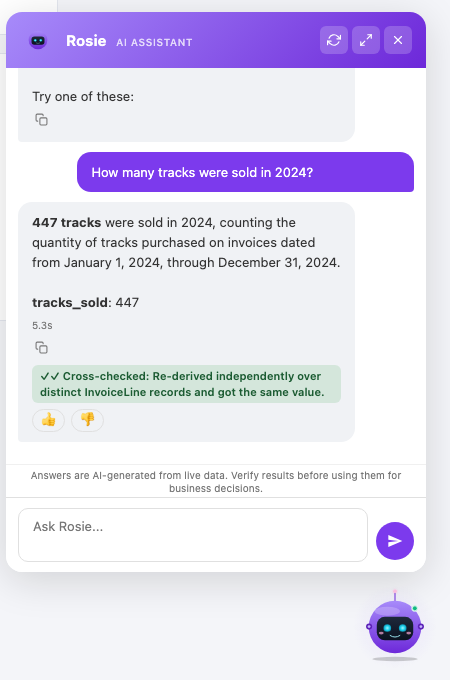
The dangerous answer is the one that looks fine.
A query that fails gets fixed. A query that runs and returns a plausible number gets pasted into a slide. On the public sample database we test with, one extra join does this, with no error and no warning from the database:
Total revenue as the query returned it. The join repeats each invoice once per line item, so every invoice is counted several times.
The same total re-derived by Rosie over distinct invoices. The answer is marked
CONTRADICTED and both figures are shown.
Inflated totals
Detects joins that repeat rows under a sum or a count, and recomputes the figure a second way.
Filters that match nothing
"Sales in Oporto" returns zero because the data says "Porto". Rosie checks the value exists and says which ones do.
Periods the data does not cover
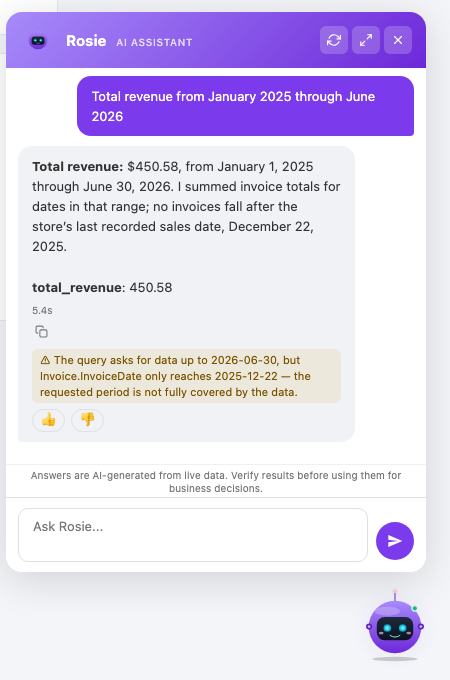
"This year" when the last record is from June is half a year. The answer says so.
Filters that remove nothing
A condition every row satisfies is usually not the condition that was meant.
Metrics the engine compiles
Declare "revenue" once, or import it from dbt or Cube. For a declared metric Rosie writes the query itself, formula and joins, so a join cannot inflate it.
Queries a person approved
A query someone reviewed for a recurring question is run unchanged when the question comes back, and the answer says who approved it.
A second attempt, before you see it
When a check names a defect, the evidence goes back to the model once. The corrected answer is used only if it checks out better.
Says what was not checked
Every answer carries a verdict. When no check could cover it, the answer says "not checked" and why, instead of looking the same as one that passed.
What it does not do
The automatic checks cover the structure of a calculation, not whether a question was understood. A misread question passes every one of them; approved queries and declared metrics are the answer to that.
Numbers you can reproduce.
Our own regression suite: 194 questions over a public sample database, the same bank on each engine, one pass. "Passed" means the answer met the suite's weighted criteria, not exact-match accuracy. 34 of the questions are traps built from the error classes the certificate covers.
| MySQL 8.4 | PostgreSQL 16 | SQL Server 2022 | |
|---|---|---|---|
| Questions passed | 191 of 194 | 187 of 194 | 192 of 194 |
| Requests that must be refused, refused | 20 of 20 | 19 of 20 | 20 of 20 |
| Trap questions | 34 | 34 | 34 |
| Trap answers that went out with no warning | 0 | 0 | 0 |
| Model cost of the whole run | US$ 0.12 | US$ 0.14 | US$ 0.13 |
We wrote that suite, so we also ran one we did not write. On BIRD Mini-Dev (2026 update: 500 public questions, 11 databases, no tuning) Rosie scores 54.4% execution accuracy, against the 51.8% baseline the dataset lists for the same model. On that benchmark almost all errors are misread questions, which the certificate does not catch: it flagged 10 of 214 wrong answers. Both results, the misses and the commands to rerun them are in the documentation.
A chat widget for people. MCP for AI agents.
Put the widget in your product with one tag, under your own name and colours. Or connect Claude, Cursor and other AI clients through the MCP server, so an agent gets checked answers instead of raw database access.
<script src="/api/assistant/widget.js"></script>
<rosie-widget api-url="/api/assistant"></rosie-widget>
One command reads your schema.
The setup wizard builds everything Rosie needs from your database: the catalog, the masked columns, the instructions, example queries validated against your data and a first question bank. About a minute and a half on the sample database.
npm run init -- --url postgres://user:pw@host/db \
     --name "My Project" --create-ro-user
npm run doctor
npm start
Runs where your data is. Reads only.
- Self-hosted. Your server, your database, your model key. Works with any OpenAI-compatible endpoint, including a model you host.
- Read-only by construction. SQL is parsed and validated before it runs: SELECT only, tables and columns from an allowlist.
- The database user is audited. At startup and every 15 minutes. If it can do more than SELECT, Rosie stops answering.
- Personal data stays put. Masked columns are never read, never returned, never sent to the model provider.
- Tenant isolation. Row policies filter every query by the caller's verified identity (JWT). Applied by the engine, not by the model.
- Prompt-injection filter in front of the model, on the question and on the conversation history.
- Audit trail of every question, the SQL it produced and its certificate.
- Tested on every commit. More than 700 security cases, plus live suites against real MySQL, PostgreSQL and SQL Server.
Six weeks, one database, your own questions.
We install Rosie next to one of your databases, build a question bank from what your teams actually ask, and report how many it answers correctly and what the certificate caught. You keep the report whatever you decide.
Talk to us about a pilot